


June 13, 2026
The following is excerpted from an article in the National Catholic Register.
Why Catholics Are Being Buried in Churches Again
By James Day
Across the centuries, Church crypts — from Roman catacombs to American cathedrals — testify that death is not the end but the beginning of eternal life.
In the Cathedral of St. John the Evangelist in downtown Cleveland, a chapel adjoins the north transept. There’s a wrought-iron gate with Requiescant in Pace fashioned above the entrance. It’s the cathedral’s burial crypt, containing the tombs of the deceased bishops of Cleveland.
 While a “crypt” implies a place under or below a structure, Cleveland’s cathedral burial chamber on the ground floor, named the Resurrection Chapel, reflects that definition as well as the tradition of burial crypts throughout the history of Christianity. It is significant that figures of both St. Peter and St. Paul are prominent on the Resurrection Chapel’s upper half of the north wall, as both martyrs of the early Church were buried in crypts: St. Peter below the altar in the basilica that bears his name, and St. Paul, buried under what is now the papal altar of the Basilica of St. Paul Outside the Walls.
A contemporary example of a burial crypt is below the apse of one of the most famous churches in the world, Barcelona’s Sagrada Familia, which began construction on the feast of St. Joseph, March 19, 1882, and is still not completed. The visionary behind the mammoth basilica, Catalan architect Venerable Antoni Gaudí, is buried in the Sagrada Familia Crypt. The crypt, completed in 1889, is the oldest part of the basilica.
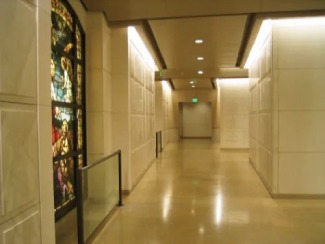
Two California cathedrals built in this century both contain crypts below the church: the Cathedral of Our Lady of the Angels in the Archdiocese of Los Angeles and Christ Cathedral in the Diocese of Orange. This intentional inclusion signifies conscious architectural, theological and artistic efforts to connect these major places of worship in Catholic California with the Church throughout time.
Among the many tombs in the Crypt Mausoleum of the Cathedral of Our Lady of the Angels is the final resting place of one of Hollywood’s finest actors, Gregory Peck, a lifelong Catholic whose 2003 funeral took place in the cathedral, followed immediately by the interment of his body in the Crypt Mausoleum.
These crypts, of course, reflect the most sacred one. “Perhaps the most significant crypt in history is that in which Jesus Christ was interred after his crucifixion,” explained Father Christopher Smith, former rector of Christ Cathedral. “The discovery that the body of Jesus was no longer in the tomb three days after his death was the first sign that Jesus was risen from the dead as he had promised. That empty tomb is forever a sign that Jesus’ promise of eternal life was fulfilled.”
(James Day is the Operations Manager at EWTN in Orange County, California.)
***
Sign Up for Healing Journey Messages
Receive a daily message to your email address.