


February 23, 2025
— Judy Collins
Living In “Ordinary Time”
My father was never late a day in his life. In fact, on the day he died, he passed away at 5 a.m., the usual time he got ready for work during his adult life.
My mother, on the other hand, was never on time; her dreamy progress through the day, the perfect pique to his anxious punctuality. With seven children, she had earned the right to inhabit her own time zone.
 I fall somewhere in between: managing to be on time for the important things and running a bit late on everything else.
For my father, being on time was a matter of character and respect, and in spite of my own routine lapses, I largely hold to that view.
“Where does the time go?” we find ourselves asking. We lose track of it, seem baffled and perplexed by its passage, wonder what it’s really about—this dimension of time that’s freed from the clock, so intimately tied with our sense of being, of living finite lives and not really understanding why we are here or what it means.
A few years back, George Will wrote an intriguing column about the amount of time we wait in line, get stuck in traffic, work at the office, brush our teeth and perform other daily routines. When he added all of that up, there seemed to be very little time for anything else, as in making time servile, we’ve lost the sense of the sacred.
Is it perhaps more Calvinist than Catholic to wonder how we work out our salvation between the lines of these mundane tasks that take up so much of our lives? Just what are the choices we make that determine the character of our souls? Perhaps as much as we come to perceive our worthiness based on our actions and choices, we overlook the need for a moral imagination that connects us with all life in sympathy and reverence.
Children have no sense of time, but they can sometimes shiver with a joy and delight that is no longer available to us. Their world is simultaneous. Then at some point, they march in time like the rest of us, bound by plans and schedules. Yet if we live long enough, we lose our sense of time as decades disappear in the blink of an eye — the leap from 40 years old to 60 like nothing at all.
Is time the distance between two places? Between deaths in the family? Between marriages and births? Do we stand still while time moves under us, so we are wind-burned by time even if for long stretches of our lives we seem unconsumed?
For a few years now, we’ve been hearing about the great proton collider in Switzerland that has unlocked the “God” particle and can explain the “Big Bang” origin of the universe. But the more scientists talk, the more it sounds like fiction, which is not to say that I don’t believe it, but simply to suggest that science (with its charmed quarks, string theory and black holes) demands its own leap of faith and seems to be moving toward metaphor in its pursuit of the ineffable.
The more science explains the universe and the outline of our experience, the greater our sense of uncertainty and doubt. We can wander through life with all of the answers and still not have a clue; only religious experience opens the door to wholeness and acceptance.
My parents died 13 years apart, and after each death, time stopped for a while and life became a blur. Yet, I eventually found myself drawn to the notion of “ordinary time” as the Church defines it — the ordered life of worship and celebration of Mass between the major liturgical seasons such as Advent and Easter. We live in ordinary time, which the Church tells us is anything but ordinary because Christ has transformed our lives by entering into our pain, suffering and death.
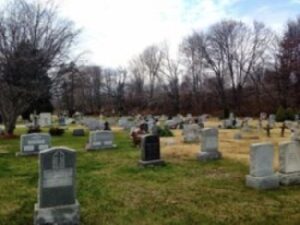
Their time is done now, I think, as I stand over my parents’ graves in the little St. Thomas Cemetery, a stone’s throw from the busy Post Road in Fairfield. Their dates are carved in stone: his, June 19, 1924 – April 25, 2000; hers, November 27, 1925 – April 12, 2013. In life they were inseparable. He loved her with everything in his soul and had to say goodbye first — it must have been unimaginably difficult.
As I stand over them, my shadow falling on the grass alongside me, I wonder about the nature of time because, though out of reach, both are still so much alive to me and the conversation that binds us continues as always.
©Brian D. Wallace
***
Sign Up for Healing Journey Messages
Receive a daily message to your email address.