


May 5, 2025
At this time of year, we often hear the term our “Easter Duty.” But what exactly is it, and why is it important? Simply put, it’s an obligation of our faith to receive Holy Communion at least once a year during the Easter Season, from Palm Sunday to Trinity Sunday.
The Catechism of the Catholic Church advises that the Communion be preceded by confession and says, “The Church obliges the faithful to take part in the Divine Liturgy on Sundays and feast days and, prepared by the Sacrament of Reconciliation, to receive the Eucharist at least once a year, if possible during the Easter season. But the Church strongly encourages the faithful to receive the Holy Eucharist on Sundays and feast days, or more often still, even daily.” CCC 1389
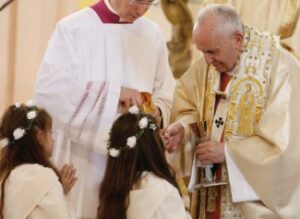 The Easter Duty serves to remind us of Jesus’ resurrection and the gift of the Eucharist, which he gave us on Holy Thursday at the Last Supper. This is the “bare minimum” requirement, and hopefully, we will strive to do much more than that.
Since the beginning of the Church, as early as the 4th century, there have been obligations the faithful were expected to follow. They became known as the five Precepts of the Church — or Commandments of the Church. They point us in the proper spiritual direction we should be following:
- “You shall attend Mass on Sundays and Holy Days of Obligation and rest from servile labor.” This refers to our “Sunday Duty” and is based on the Third Commandment to keep holy the Sabbath.
- “You shall confess your sins at least once a year.” St. John Paul II often urged the faithful to frequent confession and went weekly. Pope Francis, himself, goes every two weeks.
- “You shall receive the sacrament of the Eucharist at least during the Easter season.”
- “You shall observe days of fasting established by the Church.” We are required to fast on Ash Wednesday and Good Friday and abstain from meat on Fridays during Lent.
- “You shall help to provide for the needs of the Church.” We are all urged to support the Church with our time and treasure.
Naturally, our self-expectations as Catholics should go beyond the bare minimum, and we shouldn’t be motivated solely by adherence to formalities if Christ is the center of our faith.
Many Catholics discover that once they start to look upon the practice of their faith as more than doing the “bare minimum,” it achieves a new life, inspired by the Spirit, who compels us to do more than we ever imagined possible.
***
Sign Up for Healing Journey Messages
Receive a daily message to your email address.