


February 13, 2025
During the Victorian Age from 1837 to 1901 — long before selfie photos, videos and family albums — loved ones who died were memorialized in ways that may seem strange to us. One of the most common practices was to make what was known as “mourning jewelry” or “death jewelry,” which served not only as a way to recall a deceased loved one but also as a “memento mori,” or a reminder that you, too, will eventually die.
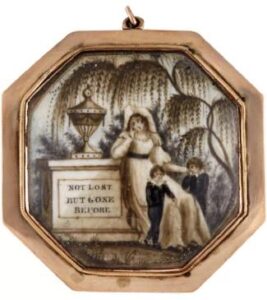 Mourning jewelry included rings, lockets, bracelets and necklaces. It was common to have locks of the deceased person’s hair made into lockets or brooches. Hair jewelry was very fashionable in 19th-century England. Hair was even used to create miniature scenes by being braided for pendants and watches. Such jewelry became so popular that by the mid-19th century, England was importing 50 tons of hair annually since the demand was so great.
Antique mourning jewelry can be found as far back as the Middle Ages, but after Prince Albert’s death in 1861, Queen Victoria set the trend for her country. The practices she followed during the last 40 years of her reign, while she was in mourning, became popular with Britain’s citizens.
Some mourning jewelry from the 1700s had dark themes and employed images of skeletons and coffins with the purpose of reminding the living to make the most of life because it could be short. Symbols found in mourning jewelry from the 1800s were less macabre and included angels, willow trees and clouds.
While most of the black jewelry was made from onyx, vulcanite and jet, jewelry to mourn a child or unmarried woman was typically designed with white enamel. If a family lost a child, the jewelry might also incorporate pearls, which came to symbolize tears.
©Joseph Pisani
***
Sign Up for Healing Journey Messages
Receive a daily message to your email address.