


September 3, 2026
“And I brought Jesus, too”
By Emily Clark
As a child, I found my mother’s pocketbook both an object of curiosity and a depository for anything one might need. It had the requisite wallet, Maybelline lipstick and car keys along with tissues and safety pins. She never liked gum but always had a few cough drops, preferably cherry.
There were our school photos with wrinkled corners, her pocket Rosary and thin, leather address book. If we were out for the day, she’d even toss in a peanut butter sandwich, so my extremely picky brother wouldn’t starve. How did it all fit in there, I’d wonder, standing tip-toed by the counter as I tried to catch a peek. It seemed to expand and grow heavier each year as it held my mother’s world. And now, so many years later, it holds even more.
Like many as they age, my mother faced a move to assisted living with trepidation. She struggled with the disconnect from my dad and their home, the life and the possessions she held dear for so long. Other than framed pictures of her grandchildren, a few pieces of furniture and her wooden crucifix and statue of Mary, few items in her small room are familiar.
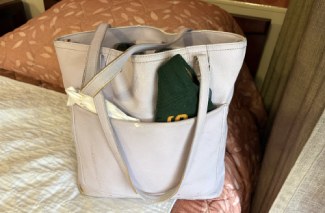 But she still has her pocketbook, as heavy and expansive as ever. No matter where she is or what she’s doing, it sits on her lap or around the arm of her wheelchair at all times. I took her medical cards, and my brother has her checkbook, but Mom remains ready to sift through that depository, happy to offer anyone a tissue or a cough drop, holding tight to what still belongs to her.
When I helped her out of the wheelchair at a recent doctor’s appointment, I put that pocketbook over my shoulder, shocked at the weight of it. “What’s in here?” I asked, wondering how much this 82-year-old needed to carry. Shifting around for her wallet and phone, Mom instead pulled out her white resin statue of the Blessed Mother, the one she kept on her dresser – or so I thought. Before I had time to react, she added, “And I brought Jesus, too.” Then out came the crucifix.
When I asked why she had them, her answer was simple: “I want them with me.” The statue she had had as a child and the crucifix was her mother’s, she explained. I nodded, trying to understand, and we sat with them, not speaking, until the doctor called us in. As she talked with him and I held the pieces carefully in my hands, I thought of my mother’s words: “I want them with me.”
Our Catechism and our faith tell us that, of course, Jesus is always with us – whether or not a one-pound crucifix or statue accompanies us. Though a faithful Catholic, my mother never carried around such pieces, nothing more than a Rosary or maybe a prayer card. But now, with fewer possessions that are hers, I wondered if she looked to them – both tangibly and spiritually – as a comfort, something to offer her a sense of peace, a sense of belonging in this constantly changing world of hers.
She was tired after the appointment and allowed me to carry her bag, but not until after she had tucked Mary and Jesus back inside. I didn’t have to wonder anymore how it all fit in there. That pocketbook was expansive, like Mary’s love. Like my mother’s too.
(This column originally appeared in Fairfield County Catholic.)
***
Sign Up for Healing Journey Messages
Receive a daily message to your email address.