


April 9, 2026
During his darkest hour, when Jesus was abandoned by his followers, a few faithful friends stood by his side. They were the women of Galilee, who had been with him from the beginning and were there at the end, during his passion, death … and resurrection.
St. Luke introduces the women in the eighth chapter of his Gospel: “Afterward he journeyed from one town and village to another, preaching and proclaiming the good news of the Kingdom of God. Accompanying him were the Twelve and some women who had been cured of evil spirits and infirmities: Mary, called Magdalene, from whom seven demons had gone out; Joanna, the wife of Herod’s steward Chuza; Susanna, and many others who provided for them out of their resources.”
Their lives are shrouded in obscurity, and yet the Gospel writers considered them so important to the story of Jesus’ last days they are mentioned by name.
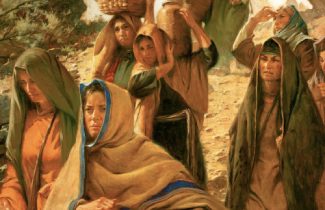 The most prominent is Mary Magdalene. For centuries, she was characterized as a prostitute, a misrepresentation attributed to a homily by Pope Gregory the Great in 591, which associated her with the sinful woman who washed Jesus’ feet, and Mary of Bethany. Now, it is widely accepted there were three Marys.
Mary Magdalene, who was at the crucifixion, the burial of Jesus and the empty tomb, was the first one to witness the Risen Christ. Mary Magdalene stood at the cross with the Blessed Mother and St. John, and went to the tomb on the third day to anoint Jesus’ body, when she encountered the Risen Lord. St. Thomas Aquinas called her the “Apostle of the Apostles” for being the first to proclaim Jesus’ triumph over sin and death. St. John Paul II described her as “one of those women [who] proved stronger than the Apostles at the moment of the crucifixion, remaining at Jesus’ side.”
Her companions may be lesser known, but their commitment to the Lord is unquestionable. Joanna, who is mentioned twice by Luke, was the wife of Herod Antipas’ steward, Chuza, who oversaw the tetrarch’s affairs. Some speculate he could have been at Salome’s birthday celebration, when Herod ordered John the Baptist beheaded. Joanna was among the women who went to the tomb on Easter Sunday, where they saw two men in dazzling white robes.
Also in their company was Salome, the mother of John and James, the sons of Zebedee. She is remembered as the woman who approached Jesus and told him, “Command that these two sons of mine sit, one at your right and the other at your left, in your kingdom. Matt 20:21” To which Jesus responded, “Whoever wishes to be great among you shall be your servant…. Just so, the Son of Man did not come to be served but to serve and to give his life as a ransom for many.” Susanna is mentioned only once by Luke but is assumed to have traveled with the other women, assisting Jesus and the apostles. She was likely present at the crucifixion, the burial of Jesus and the empty tomb.
Mary, the wife of Clopas, also known as Mary, the mother of James and Joses, was present at the death and burial of Jesus. Matthew says she was with Mary Magdalene on Easter morning. She is believed to have been an aunt of Jesus. Some scholars even suggest that her husband could have been Cleopas, who encountered Jesus on the road to Emmaus, and that she might have been the unnamed traveler accompanying him that morning.
In an article in “St. Anthony Messenger,” Theresa Doyle-Nelson wrote: “They [the Galilean women] were there, they were helpful, they were devout, they were fearless (braver than most of the apostles at the Crucifixion), and they loved Jesus dearly and showed it. At least Mary Magdalene and Mary of Clopas were blessed by being the first to see Jesus resurrected.”
©J Pisani
***
Sign Up for Healing Journey Messages
Receive a daily message to your email address.