


April 23, 2025
After Jesus’s death and resurrection, the early Christians looked upon death and burial entirely differently. Unlike the pagans, they had the promise of everlasting life.
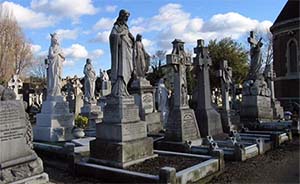
From the very beginning, Catholic cemeteries were consecrated holy ground. The Acts of the Apostles and writings of Tertullian offer evidence of new burial customs, and their consecration dates back as early as the 6th century. In addition, Catholic cemeteries are sacred because martyrs and saints known only to God are laid to rest there in anticipation of the Second Coming of Jesus, when they will rise again.
 At first, the faithful were buried in private tombs owned by the wealthier Christians, and later underground cemeteries known as catacombs were created throughout the Roman Empire, notably in Rome where martyrs were buried. Their graves had a special significance for the early Church.
During the persecution of Christians, around 258 AD, the bodies of St. Peter and St. Paul were moved to the catacombs. For about three centuries the common practice was to bury the faithful in tombs owned by wealthy Christians outside the walls of large cities, and eventually the catacombs, which were hewn from soft rock and had public entrances.
This type of burial was practiced in major cities, such as Rome, Naples, Paris and Syracuse in addition to Syria and Egypt and other countries.
They gathered for religious services in the catacombs. In the fourth century when the persecution of Christians ended, they began to create open-air cemeteries.
In the Middle Ages and until the mid-17th century, church cemeteries were places to gather like a public square.
“Cemeteries were protected by the privilege of sanctuary or asylum and were protected by the patron saint from abuses by civil authorities,” author Ann Ball wrote in the Encyclopedia of Catholic Devotions and Practices. “Here the people conducted their spiritual and temporal business, and played their games…”
Hermits who lived a solitary life of prayer would reside there, and judicial proceedings were held in cemeteries. In the 15th century, Joan of Arc was tried in a Catholic court in the Saint-Ouen cemetery in Paris.
©J Pisani
***
Sign Up for Healing Journey Messages
Receive a daily message to your email address.