


April 13, 2025
“We think sometimes that poverty is only being hungry, naked and homeless. The poverty of being unwanted, unloved and uncared for is the greatest poverty. We must start in our own homes to remedy this kind of poverty.”
— St. Teresa of Calcutta
The incorrupt body of a small hunchbacked woman lies at the base of the altar at the Church of St. Dominic in Castello, Italy. She’s a woman born more than 700 years ago, blind and lame, a woman of nobility whose family abandoned her as a child and forced her to beg on the streets to survive.
St. Margaret of Castello, whose feast is today April 13, is also a woman whose sanctity inspired thousands of people to attend her funeral when she died at 33, and over the centuries, her intercession has been attributed to many miracles.
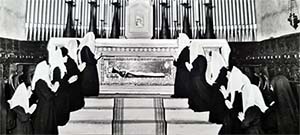 “Little Margaret,” as she was called, was born into a family of wealth and prestige in a castle near Perugia, Italy in 1287. Her parents wanted a son to carry on their noble ancestry, but God gave them a daughter who was blind and deformed. In our era of prenatal testing and eugenic abortion, Little Margaret would never have been born.
At 6 years old, her parents made her leave the castle and imprisoned her for 13 years to keep her out of sight. Despite her poor health and deformity, she was intelligent and full of goodness, and she loved God with a contagious fervor.
When she was 19, her parents took her to Castello to seek a miracle, but ended up abandoning her in the church. All alone, she lived as a beggar on the streets, until the poor townspeople adopted her as their own.
Little Margaret eventually became a lay Dominican and spent her final years doing acts of charity and mercy, visiting prisoners, assisting the sick and comforting the dying, until she died. Today, she is recognized as the patron saint of the unwanted.
Despite her personal suffering, she brought joy and love to many others afflicted by a spiritual sickness common in the 21st century — they are “unwanted.”
The unwanted can have many different faces. They’re the unborn, the incurably ill, the handicapped, the elderly, the poor and the dispossessed. And they share one thing in common: Their dignity as human beings is denied in a society that often doesn’t value the weak and the infirm.
©J Pisani
***
Sign Up for Healing Journey Messages
Receive a daily message to your email address.